Kleinberg Model
- Motivation: Watts-Strogatz Model captures the Small-World Effect, but it fails to explain the efficient decentralized search in social networks.
- Lower bound of 1D decentralized search:
- Decentralized: agents know the locations of other agents (geographical, before adding long-range edges), their neighbors, can distinguish a long-range neighbor from a local neighbor, and can even know if their neighbors have long-range neighbors, but they do not know the locations of long-range neighbors of a neighbor.
- : the number of steps of a decentralized search algorithm to find a target node from a source node , with chosen uniformly at random.
- Lower bound of 1D decentralized search:
- Model 1D
- Watts-Strogatz Model with and without removing original links
- Add shortcuts
- For each shortcut, it connects two locations apart with probability for some positive parameter , with the locations chosen uniformly at random among all pairs of locations apart
- Model 2D
- Agents are 2D lattice points on a grid, each connected to its 4 nearest neighbors w.r.t distance
- Each agent has a shortcut, which links to another agent at distance with probability for
- Expected steps
- 1D: when ; o.w.
- 2D: when ; o.w.
- Intuition
- The shortcut should not jump too close that it does not give enough progress, and should not jump too far that it always skips the target when it is close
- An ideal search method is hierarchical that progressively narrows down the search space
- The letter is first sent to anyone in the US, then to anyone in Massachusetts, then to anyone in Boston, and then to the target person
- Uniformly random shortcuts preclude such a hierarchy
One Dimensional
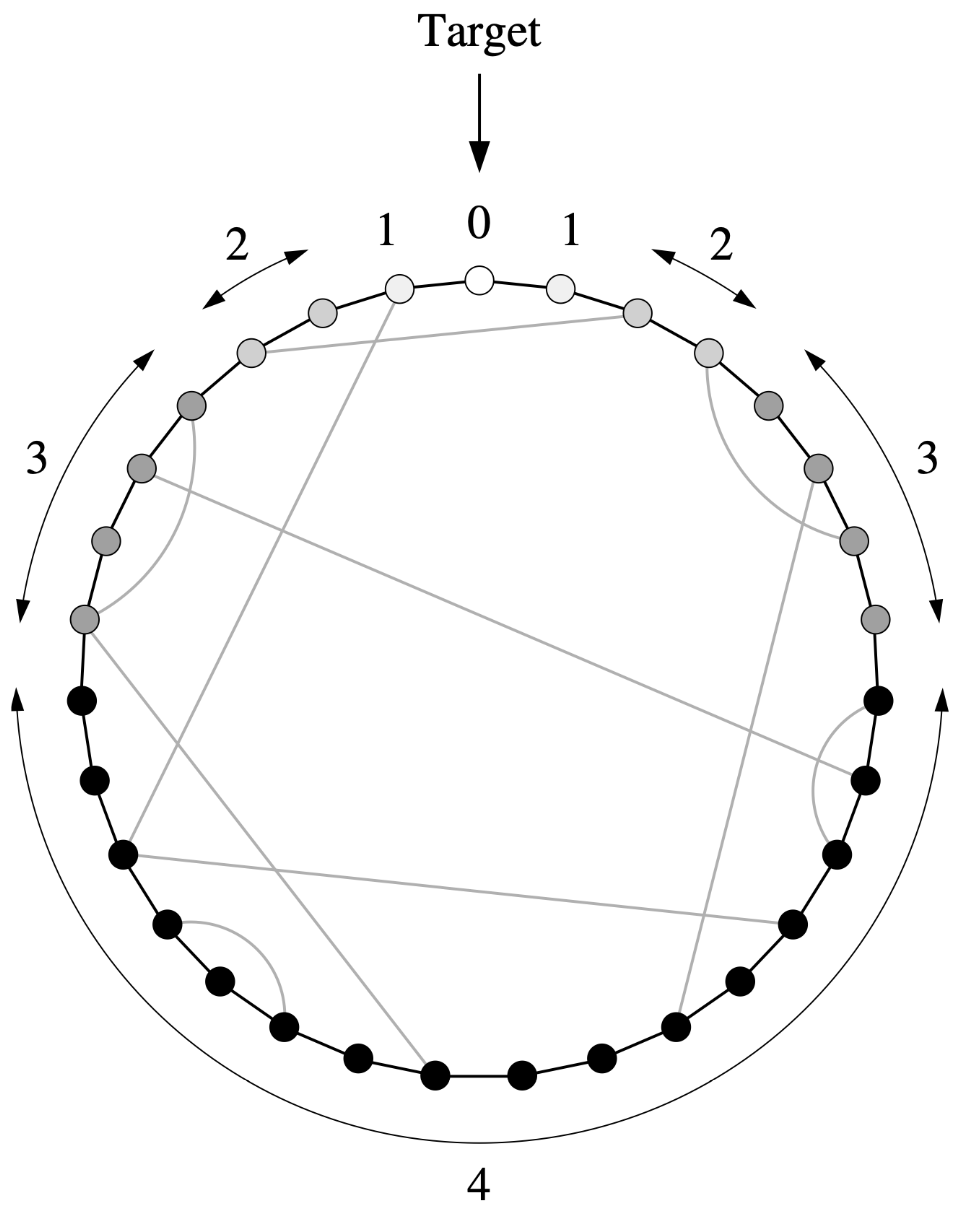
Suppose agents know the locations of other agents, i.e., the geographical distances on the ring graph. Then, agent can partition the ring into classes: Class 0 contains , Class 1 contains the two 1-hop neighbors of , Class 2 contains -hop neighbors of for with total nodes, …, Class contains -hop neighbors of for with total nodes, …, Class contains the remaining nodes. We have .
We consider the following algorithm : when the current agent is in Class , it passes the message to a lower class neighbor if there is one; otherwise, it passes the message to another Class agent through either a shortcut or a local edge.
Let be the normalizing constant for the distribution of shortcut range . Note that there are agents in the lower classes, each of which is at most hops away from the current agent. Thus, the probability of a Class agent having a shortcut to a lower class is at least
where the factor comes from the fact that the shortcut can be in either direction. Then, the expected number of steps of staying in Class , which follows a Geometric Distribution, is
Thus, the expected total number of steps is bounded above by
Note that
Finally,
Two Dimensional
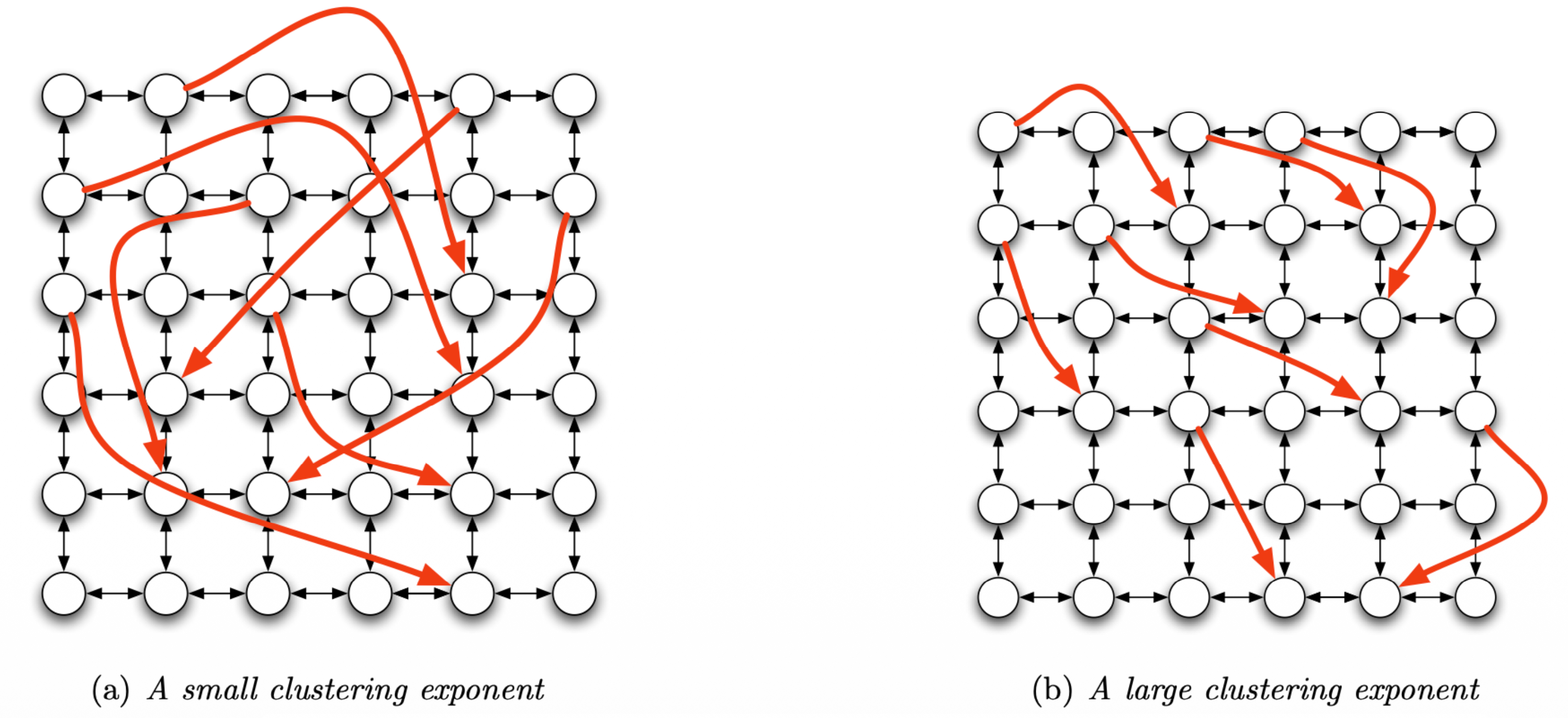
Note that the number of agents within distance to comprises a diamond with agents.
When , i.e., shortcuts are uniformly random, the expected number of steps is , proved similarly as Lower Bound by setting .
Similar to One Dimensional, we partition the agents into classes with Class being the -diamond minus the -diamond, which contains agents. The algorithm tries to move to a lower class if possible; otherwise, it moves to another agent in the same class.
The normalizing constant of the distribution of shortcut range is
Thus, the expected total number of steps is bounded above by
General Hierarchical Model
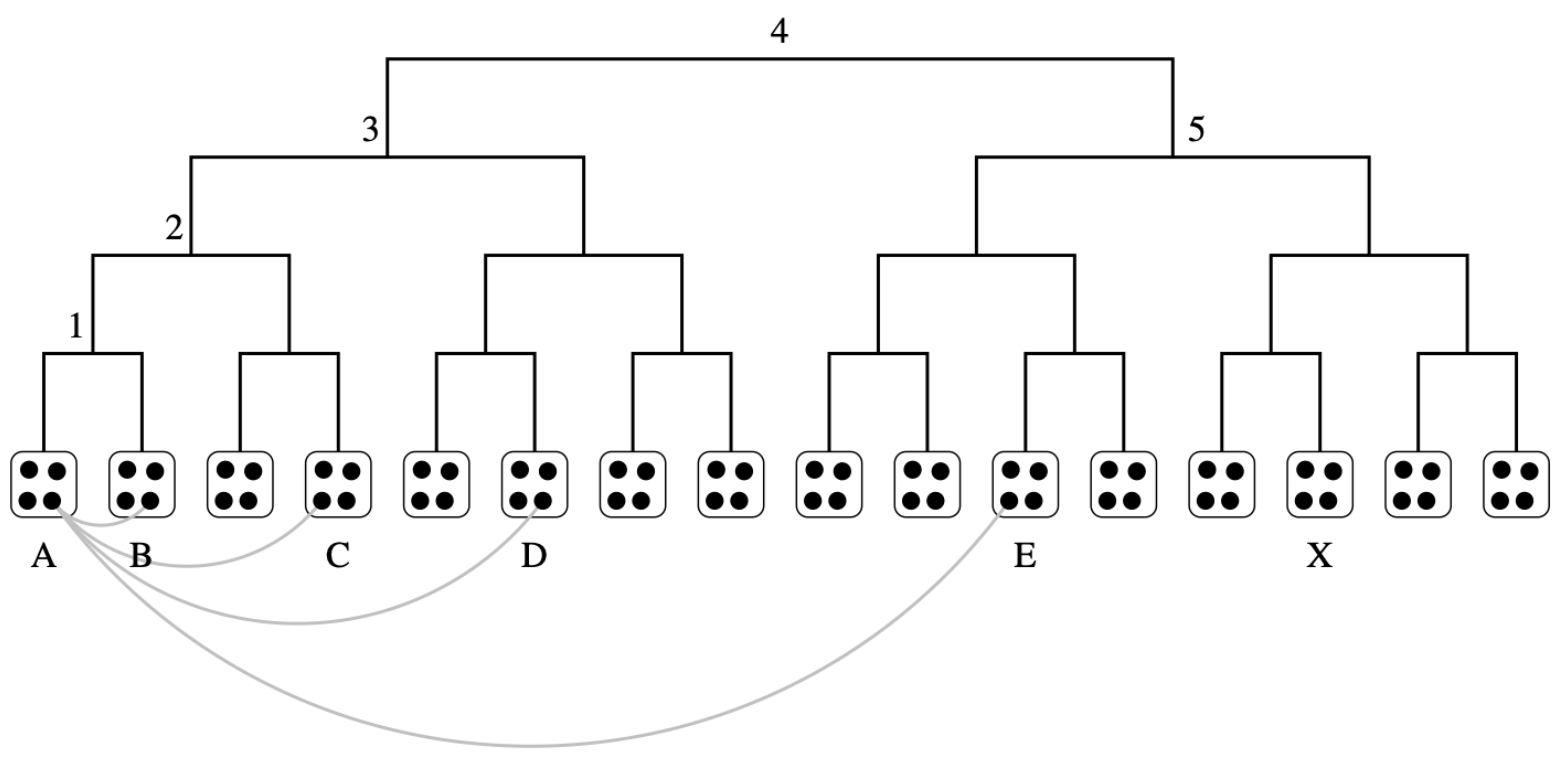
Generalizing the Kleinberg model, Watts et al. consider arbitrary networks with a shortcut mechanism specified by another shadow hierarchical tree network. Agents are grouped by the leaf node they belong to. For simplicity, we assume a binary tree with the same group size . More restricted than the Kleinberg model, we assume the agents only know the tree distance between them, i.e., the height of their lowest common ancestor. Any two agents of tree distance is connected by a shortcut with probability , where controls the expected number of shortcuts an agent have, say .
Similarly, the algorithm lets an agent at tree distance passes the message to an agent that has a smaller tree distance to the target, i.e., the opposite subtree at height , if it can; otherwise, it passes the message to another agent in its own subtree at height . ^[Unlike the Kleinberg model, we cannot guarantee that the message will move into the opposite subtree; in such a case, the algorithm fails] The expected number of steps of staying at its own subtree is upper bounded by
Thus, the total expected number of steps is bounded above by
Note that and
Finally,
recovering the same result as the Kleinberg model.
- This model reveals the design of the critical regime , which renders constant: the decrease with distance in the probability of knowing a particular person is exactly canceled out by the increase in the number of people there are to know.
Lower Bound
One Dimensional
Given ant , we partition all nodes into three classes , , and , where , are the 1-hop long-range neighborhood and -hop short-range neighborhood of , respectively. is to be determined later. For simplicity, consider a Watts-Strogatz Model where (ring graph) we random long-range edges are added instead of rewiring. Then, since is uniformly random, we have
and
If , an algorithm needs only one step to find . If , any algorithm needs steps to find . If , let be the next node chosen by algorithm after . Since does not know if has a long-range edge to , . Note that has long-range neighbors in expectation. If chooses a long-range neighbor , we have
If chooses a short-range neighbor, can move slightly closer to but not much, so approximately we still have . Therefore, the algorithm approximately follows a Geometric Distribution with “success” probability . Suppose . Then this probability is of . Then, the expected number of steps until success is of . Since , overall, we have
setting whose derivative with respect to to zero gives and
Two Dimensional
Case I. . Similarly, let be the -diamond around , which contains nodes. Suppose , then is outside of w.h.p. Then, the “success rate”, i.e., the probability of any node outside of having a shortcut to is upper bounded by
Since, , . Then, the expected number of total steps is of order
Case II. . . See Problem 1 Navigation Case III. . . See Kleinberg 2000.