Bias-Variance Trade-Off
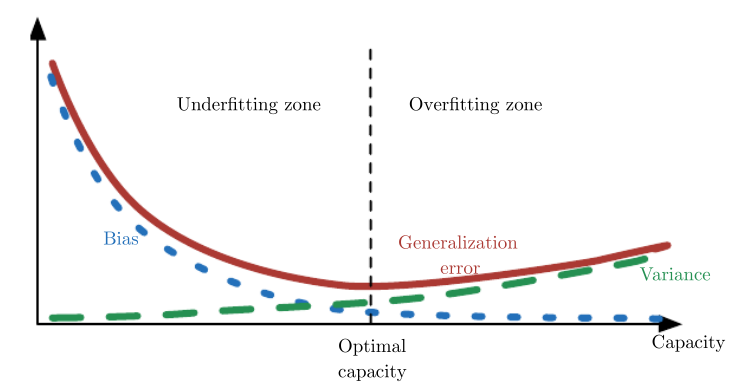
- An illustration of the relationship between bias, variance, Overfitting and Underfitting.
For Linear Regression
For a weight estimation , we want to evaluate the error of new estimates. Specifically, let be the training data and be a new observation with a real target . We want to evaluate
Assume ,
We see this generation error decomposes into
- Measurement error
- Squared model bias : how close to the real solution (expected)
- Model variance: : how sensitive the estimation is
For Maximum Likelihood Estimation, the model bias is zero, but the variance if high; for Ridge Regression, the variance is reduced, though it is a biased estimator.
General Regression
For model and the approximator , the expected error for new data is
In Other Statistical Tasks
Bias-variance trade-off was originally formulated in regression tasks. But it’s also prevalent in other statistical decision-making tasks, especially when using quadratic Risk. For example, the same analysis applies to Estimation with Mean Squared Error.
Trade-Off Negotiation
Two common ways to negotiate the trade-off between two: